This week Steven and I met up for a virtual hallway chat with Dr. Sarah Hogarth Rossiter. Sarah shared with us what’s it like to be a contract instructor (on short notice) at Douglas College for Summer 2020. In addition, we chatted about some of her thoughts around the importance of critical thinking under COVID-19 times.
Listen to the Kelly Hunt song, “How Long” that Sarah mentioned for some food for thought while we’re apart. Check it out! https://youtu.be/ElwRHoDOjpE
Please share your thoughts, comments, and suggestions with us as the podcast continues to grow.
We would like to acknowledge that we live, learn, work, and play on the unceded traditional territories of the Coast Salish Peoples of the QayQayt and Kwikwetlem First Nations.
with hosts Lisa Smith (Sociology)& Steven Bishop (Learning Design)
With the spread of COVID-19 across the globe, the Summer of 2020 is profoundly different for Douglas College faculty, staff, and students. Winter 2020 ended abruptly with a move to on-line teaching for the remainder of the term. For folks teaching summer courses at Douglas College, for the first time ever, all course instruction will be on-line. Dare we say that the phrases, ‘I’m scrambling…’, ‘I’m freaking out…’, and ‘when will this be over’, have certainly become common enough! We are just beginning to realize the vast and far-reaching impacts of this virus on individuals and communities across the globe. Many members of our community are grappling, both directly and indirectly, with the fallout of this massive social upheaval.
For instructors there is an imminent and ongoing need for technological support; however, the nuts and bolts of navigating on-line teaching are not the central focus of this podcast. This podcast is about hearing from DC faculty, staff, and students, as they navigate through the on-line realm in these novel times.
We had many questions at the outset of this podcast: What was it like to move everything on-line within a week? What things did you try, but found didn’t work? How do you build a sense of connection and community when teaching in on-line spaces? How do you cultivate presence as an instructor when teaching on-line? How do you manage the complex patterns of inequality that continue to shape how students gain access to education? Are we aware of all the ways our students are impacted by COVID-19 (emotional, physical, and beyond)? What kinds of things do you consider when making choices about content delivery? What is it like to instruct from home? To learn from home? To work from home? What expertise can you share with us to help us understand the social changes that are unfolding? What are your hopes, fears, worries for this time?
Even though the questions are complex, the format is simple. Guests are invited for virtual hallway chats. We record the conversation and share with others. We chose the hallway chat model to replicate one of the benefits of the close quarters we inhabit as HSS Faculty. We have the privilege of ‘running into’ each other throughout the term. We find these conversations rich opportunities for learning about the work of our colleagues, trouble-shooting small issues, or even delving into deeper reflection. For each chat session we will post any additional reading materials that are mentioned in the recording.
We invite you to listen, share, and create with us as we explore the depths of our new digital humanity.
The first podcast is an interview with Joseph (Joey) Moore, Professor of Anthropology and Sociology at Douglas College. He has research interests in environmental sociology, urban sociology, and social movements.
Hallway Chat 1: Joseph Moore (Sociology)
Steven and I were pleased to welcome Dr. Joseph Moore, Sociology, for our first virtual hallway chat.
In this chat, Joey mentions Arlie Hothschild’s book, The Time Bind: When Work Becomes Home and Home Becomes Work, first published in 1997.
Check out his co-edited collection, Sociology of Home: Belonging, Community, and Place in the Canadian Context
We would like to acknowledge that we live, learn, work, and play on the unceded traditional territories of the Coast Salish Peoples of the QayQayt and Kwikwetlem First Nations.
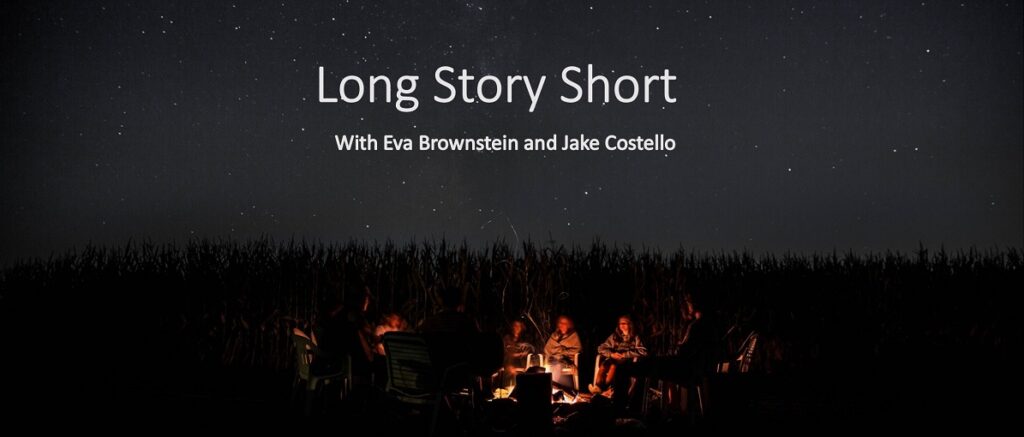
On September 23, Eva Brownstein, documentary filmmaker, and Jake Costello, Studio Director for CBC’s The Early Edition, led a workshop at Douglas College on incorporating documentary and news story-making elements techniques into courses. Eva and Jake help others tell their stories, nurture stories, and reveal meaning buried in information through film and radio media. The workshop was mediated by Steven Bishop, Douglas College Learning Designer.
We started with a brief discussion of two premises:
We have been using Story since before the beginning of civilization (15,000 years or more if we consider the earliest known cave paintings as comprised of story elements).
Learning relies on the ability to imagine a past, and a future. Storytelling and story receiving are coeval with the conception of time.
“Between the continuous barrage of information and madness, stands only story. Eva and Jake are skilled story makers; they each play an important part in informing others about the meaning of events in our world. As Douglas College instructors and people transmitting knowledge to others, we hope to learn from their experience how to shape information and fact into story. It might not seem apparent that producing news and crafting documentaries involve similar skill sets to lesson planning and curriculum delivery. This quote from Yuval Harare speaks to me about how we are all involved in creating and receiving story. After listening to news (let’s say CBC’s Early Edition), I feel informed. After watching a documentary, I feel moved. In both cases, I care about what I have just experienced. The root of the word “education” means to care, to nurture. That is what Eva, and Jake, bring to us today: story as education.” from introduction by Steven Bishop
“…the last thing a teachers needs to provide today… is more information for they already have far too much of it. Instead, people need the ability to make sense of information, to tell the difference between what is important and what is an important and above all to combine many bits of information into a broad picture of the world.” Yuval Noah Harare in 21 Lessons for the 21st Century
Listen to a recording of the first half of the workshop
Read the transcript for the first half of the workshop
We would like to acknowledge that we live, learn, work, and play on the unceded traditional territories of the Coast Salish Peoples of the QayQayt and Kwikwetlem First Nations.
Michelle Jickling, who is currently working as an Instructional Designer and eLearning Developer with the Training Group at Douglas College, and I sat down for a conversation about the essentials of helping subject-matter experts and instructors with course development. We specifically addressed some of the initial concerns with translating the expert’s knowledge to an online environment, such as the Blackboard LMS currently used by the College.
Our discussion touched on:
Starting from scratch: storyboarding, assessing learning needs, organizing existing content, reviewing the learning goals
Meeting desired outcomes vs. delivery of information
Scaffolding into advanced knowledge
Iterative processes and updating content
Discipline-specific priorities
Synchronous and asynchronous modalities – how best to meet the student where they are
Modern educational and life challenges for students
Relevancy in course design and assessments
Balancing an expert’s knowledge with time constraints (the 80:20 rule)
Time expectations
Listen to the 8:30 minute recorded dialogue
We would like to acknowledge that we live, learn, work, and play on the unceded traditional territories of the Coast Salish Peoples of the QayQayt and Kwikwetlem First Nations.
Lisa Smith and Steven Bishop facilitated a workshop at Douglas College that opened up discussions about listening and encouraging student voice, examined Lisa’s process of developing a podcasting assignment in her Gender and Youth Cultures class, and provided some basic audio recording information. The workshop included:
Listening as practice (activity)
A case study of the development, implementation, and showcasing of a classroom podcast assignment
Examples of student and expert podcasts
Skills inventory (activity)
Technical overview of audio recording, editing, and producing
Live recording demo with Audacity software and Yeti microphone
Full group discussion of how to bring this approach into the class
We would like to acknowledge that we live, learn, work, and play on the unceded traditional territories of the Coast Salish Peoples of the QayQayt and Kwikwetlem First Nations.
In this final podcast of the series, Steven Bishop and Lisa Smith, sit down with Kelsey Huebchen, a Douglas College student who was enrolled in GSWS 2101 and completed a podcast as part of her course work. From an instructor perspective, Lisa discusses some of the benefits of exploring podcasting as a pedagogical and evaluative tool. Kelsey reflects on some of the differences between producing a podcast and writing a research paper.
Lisa recommends instructors keep in mind the following if considering podcasting as an assignment:
1) Introduce the idea early on in the course.
In my class, I discussed the podcast assignment in-depth on the first day of class and had printed copies of the assignment guideline. I took time to go through this with students to ensure that they understood that this was a part of the course and that they would have time to acquire the skills / knowledge required to complete this assignment.
2) Identify student skills and concerns early on.
In the second course of the semester, I had students work in groups to complete a questionnaire that identified concerns about the podcasting assignment, as well as any existing skills that they already had that would be helpful for this project (for example, do you know how to use the voice recorder on your phone). Following this, we conducted a “skills inventory” of the class as whole. This was really helpful for identifying the different skills that students already had, but also which students might be able to provide assistance to others.
3) Keep podcasting as a subtle, but constant theme throughout the course
Each week, we would listen to a podcast in class. This allowed us to use podcasts as a way to get further into topics we were reading about, but also allowed me to share different kinds of podcasts with students to demonstrate that there were different ways to approach this assignment. Students enjoyed discussing the subject matter in the podcasts, as well as the various elements of production.
4) Focus evaluation on the planning / organization / research for the podcast.
For this assignment, only a portion of the total grade was based on the actual finished product. Further, students were not graded on the technical quality of the podcast.
5) Establish a reasonable time limit for the final podcast product.
As an instructor, keep in mind that you will need to listen to ALL the podcasts. Be sure to consider how much time is reasonable for you to spend listening to podcasts at the end of term.
A meta-cognitive look at creating an audio-recording based assignment
Episode II – 8:19 minutes
After our initial meeting, Lisa Smith and I met for a second time with a more decided perspective on how to proceed with creating an audio-recording-based assignment for her Gender and Youth Cultures course. We are capturing the design process with these recordings and our hope is that other instructors and designers will benefit from our work when considering or creating similar assignments. One additional benefit we have noticed is the reflective nature of reviewing what we discussed while editing. Even if we weren’t going to share these recordings, it has been a valuable experience in understanding dialogue, the other person, and how we communicate ideas.
Podcasting – A Teaching with Technology Paper by Ashley Deal, Carnegie Mellon University June 4, 2007
Licensed under Creative Commons Attribution-Noncommercial-No Derivative Works 3.0
In a recent Teaching in Higher Ed podcast (#153), Douglas College instructor Brandy Dudas explains her use of pencasting and other ways of introducing videos into her classroom. She says it all started with students asking her to post videos online, enabling them to review difficult concepts repeatedly to ensure they really grasped the necessary learning. She even has her own YouTube channel called Accounting Videos with Brandy, which is clearly popular with her students.
Grab a coffee and your iPhone, then give this podcast a listen. It’s passionate educators like Brandy who are truly making a difference in students’ lives.
Media creation (videos for class instruction or promotional activities, podcasts, etc.) is everywhere these days. Think YouTube, Lynda.com, the Khan Academy. This is the new way of acquiring knowledge and delivering your message to large audiences.
Creating video and audio recordings can serve to humanize the online environment, convey deeper meaning, and provide a catalyst for social and instructional presence. Some of the uses for educational media include:
short instructional/promotional videos or audio recordings
just-in-time tutorials
collaborative peer assignments
formative assessments
digital storytelling projects
At Douglas College, we just rolled out our new EdMedia Program, which, once completed, will provide participants with the skills to create their own educational media designed for their specific purpose, whether that means producing a video or launching a podcast, and ultimately, reaching your desired audience. Graduates leave with a deeper understanding of the creative process and assets that can be used in the classroom, in online courses, or for promotional purposes.
Now for the details. The program consists of six workshops held over a six-week period. Enrollment is limited to ensure a meaningful hands-on experience. Participants have the opportunity to work in recording/editing studios alongside like-minded colleagues and creative professionals from Academic Technology Services. A certificate will be awarded to participants who complete the following courses; however, courses can be taken individually and accumulate towards the certificate.
Recording Foundations:Pre-production and planning
Thursday, May 25, NW MousePad (room N3142) 9:00-11:00 am
Video Recording Techniques:Lights, camera, action
Monday, May 29, Studio (room N3272V) 9:00am-12:00pm
Guerrilla Filmmaking:Portable device techniques
Thursday, June 8, Dance studio (room N3260) 9:00am-12:00pm
Audio Recording:Editing with Audacity/Podcasting
Thursday, June 15, Studio (room N3272V) 9:00am-12:00pm
Showcase and Next Steps. Next steps to integrate recordings into courses (e.g., Blackboard tools, WordPress sites)
Monday, June 19, NW MousePad (room N3142) 9:00am-12:00pm
If you’re a member of the DC community and are interested in registering, click here.