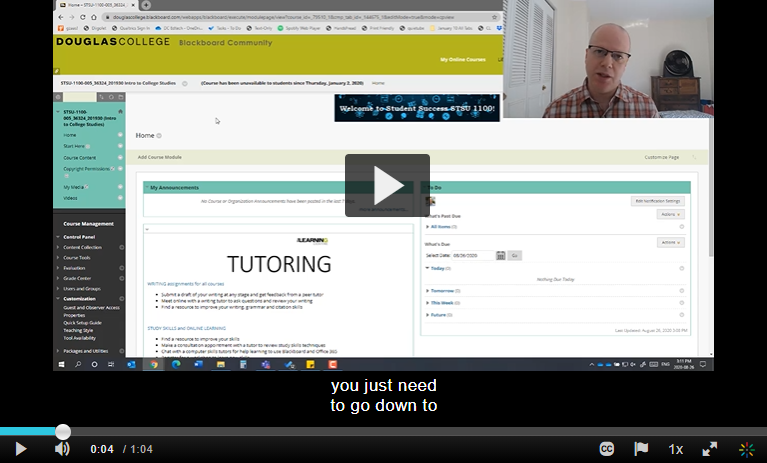
By default, students will only be able to access your Blackboard course on the first day of the new semester. You may want to make your course available to students before the first day of classes. If you do, here is how you do that.
Click on the image below to watch the video (1 min.).
The LLPA Academic Integrity Committee came up with a number of scenarios that are related to the different areas within LLPA. Each of these scenarios has been turned into Blackboard quiz and also some interactive elements that can be added to your Blackboard course.
Here is one example scenario that has been turned into an interactive element:
If you are wanting to use the Blackboard quiz or the interactive elements, you can find the files along with the instructions on the LLPA Blackboard Site under Additional Material. There are videos there to give you an overview of the resources along with instructions on how to install them.
Please let me know if you use these resources along with comments on how we can improve them.
If you are interested in learning about using videos in Blackboard, this is a recording of a workshop I did on using Kaltura. It gives you an overview of Kaltura and how it can help you avoid storage space issues in Blackboard. It also touches on Kaltura Quizzes and how they can be a way of having students interact with a video and for keeping track of how much of they video they have watched.
Click on the image below to watch the workshop recording.
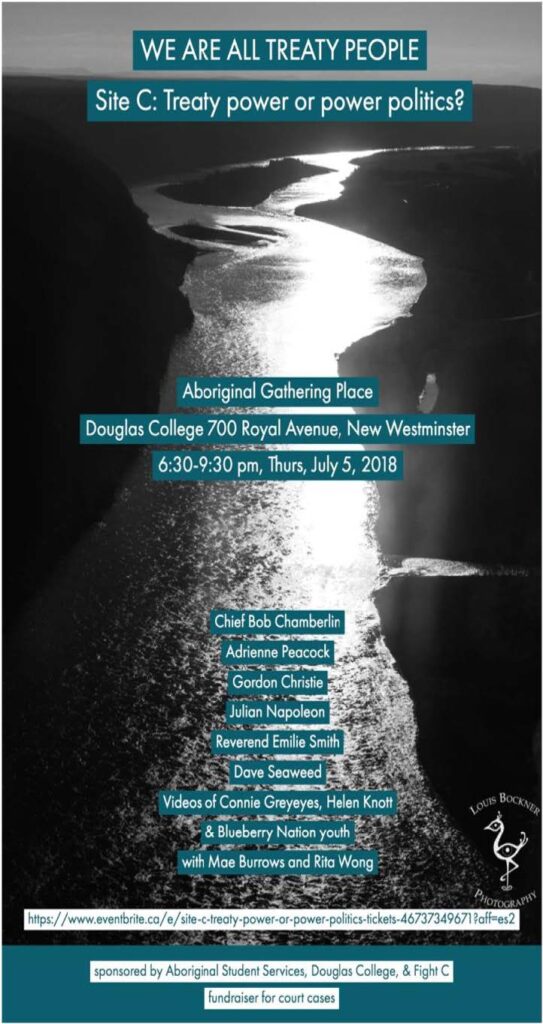
Chief Bob Chamberlain of the BC Union of Indian Chiefs
As the elected Vice-President of the Union of BC Indian Chiefs, Chief Chamberlin takes an active role in the defense of Aboriginal Title and Rights and is committed to overcoming the challenges and impacts of fish farms in the Broughton Archipelago. Further, he frequently engages in lobby efforts at both the provincial and federal levels to ensure the protection of First Nations water rights and safe drinking water for our communities.
Gordon Christie, Professor of Law, Peter A Allard School of Law
Professor Christie is of Inupiat/Inuvialuit ancestry and researches in the areas of Aboriginal rights, Aboriginal title, indigenous self-determination, and the Crown’s duty to consult and accommodate Aboriginal groups. Professor Christie’s research also focuses on the intersection between indigenous law and Aboriginal law that has developed through Canadian jurisprudence on section 35 of the Constitution Act, 1982.
Julian Napolean, Dane-Zaa and Cree from the Salteau First Nation in Treaty 8 Territory and Member of the Working Group on Indigenous Food Security
Adrienne Peacock, Faculty Emeritus, Douglas College, Department of Biology
After graduating with a Ph.D. in Zoology from UBC, Adrienne worked as a consultant to an environmental group and then, for over twenty years, taught biology, ecology and environmental science at Douglas College.
Reverend Emilie Smith, Rector of St.Barnabas Anglican Church, New Westminster
Dave Seaweed, Aboriginal Students Coordinator, Douglas College
Accessibility:
Please message the organizers with any accessibility concerns. Best entrance from campus parking lot or Royal Ave for those with mobility concerns. Barrier free washrooms available.
(Posted at the request of Stephen Crozier, Douglas College)
Recently we held a workshop at Douglas College titled “Creating emotional safety in learning spaces,” which was facilitated by Leva Lee of BCcampus; Sandra Polushin, CFCS faculty; and Steven Bishop and Hope Miller from the Learning Designer team of Academic Technology Services.
And how did we land on this topic? Well, it started over a year ago when Ross Laird presented a two-day workshop titled “Storming the Ivory Tower.” As one plank of his 10-plank framework, emotional safety is a critical component of teaching the whole person.
Our goal in running this workshop was really to start a dialogue at Douglas College about what emotional safety means and how it impacts each of us in our various learning environments. None of the facilitators professed to being an expert in the field of emotional safety, but they were willing to guide the discussion around this important topic.
To that end, the facilitators used Liberating Structures activities to generate thoughts, ideas, challenges, and solutions, as well as to model how such topics could be tackled in learning environments. Two hours flew by as participants completed three activities–Impromptu Networking, Drawing Monsters, and 1-2-4-All–each activity building on the insights gleaned during group work.
I’m happy to report that feedback from participants was very positive. They liked the format and saw the benefits of using Liberating Structures to delve into topics such as emotional safety.
But, did we succeed in creating an emotionally safe space for participants to come together, share, tackle tough topics, and problem solve? Absolutely.
I am getting better at answering the question, “What you are talking about is important, but what does that have to do with technology?” This question is probably more implied, and probably more personal and internal, than one I am asked by others directly. My job title is Online Learning Designer, a role that involves:
supporting faculty with their use of the college’s Learning Management System (LMS)
collaborating with educational and informational technology staff to ensure currency and quality of online learning environments
instructing faculty in the design and production of online learning objects
providing “exceptional client-centered service on a consistent basis to all stakeholder groups”
Depending on what one thinks technology means, there is lots of room for interpretation of the above functions. Because the environment is technological (e.g. digital, computer-based, online), there can be an assumption that the primary work is within prescribed technologies. Ursula Franklin, defines a prescriptive technology as that which “Each step is carried out by a separate worker, or group of workers, who need to be familiar only with the skills of performing that one step. This is what is normally meant by division of labour.” (Franklin, 1990)
Franklin also identifies holistic technology as “…associated with the notion of craft” and involving decisions that can only be made while the work is in process, by the artisan themselves. Holistic technology is endangered in our modern, compliance-based, and prescriptive technological environment, where one misplaced character in a line of code causes failure, and where algorithms decide what information we are fed on our smart phones and computers.
How is it that I am precisely at the perfect distance to the sun, so that the moon exactly eclipses the sun?[i] And the sun warms but does not destroy this place?
Where is the closest place I can walk on the earth with bare feet? Drink from a pure stream? Slip into a clean lake or river?
When was the last time I scared a mountain lion with only my voice and fierceness away from its prey and saved a little dog?[ii]
Who lived here before me? And who lived here before them? How far down would I have to dig to find the ancestors of this place? What did they find to eat, only here? Wrap themselves in, from only here? Create shelters from only here? Heal their wounds and ailments, from only here? Remember their predecessors to this place?
How will my successors appreciate what I have done here? How I have lived? What love I have received and given here?
How am I to respect, appreciate, and honour this place?
I wrote this reflecting on several overlapping themes in my work and personal life. I am participating in an Indigenous Studies Working Group at Douglas College, in conversation with friends and family who live in semi-remote rural places, and working on developing a new program that strives to use digital tools to enable instructors and students to co-create place-based learning objects that reference local history, environmental concerns, economics and vernacular sensibilities. I am interested in collaborating with others with similar interests…
by Steven Bishop
[i] As relayed during a conversation with Dr. Paul Jacobson (Jacobson, 2017)
[ii] As relayed during a conversation with Susan Aldridge, who did exactly this during a walk on her land in the Slocan Valley. (Aldridge, 2017)
[iii] “All my relations” is a saying used to express awareness of the interconnected nature of the universe. We hear it often as part of Indigenous welcoming to British Columbia post-secondary events. “It also reinforces that everyone and everything has a purpose, is worthy of respect and caring, and has a place in the grand scheme of life.” (Kaminski, 2013)