Karine Hamm, Coordinator, Sports Science Diploma and I met to discuss a DESC project we are working together on involving a series of recorded interviews and dialogues with colleagues, students, and other educators that will address the topic of Reimagining Post-Secondary Education.
Here are some links to things mentioned in the recording
Transcript of the Studio23 Panel: Experiential Learning and Social Change Through Projects in Studios, Labs, and Maker Spaces quote from Paula Ortiz: “I think the biggest thing is I’ve had professors mention that or teach that we should learn to embrace and learn the new technologies coming out rather than be against them. Because I read an article that came out not too long ago about the top 30 jobs that are about to be replaced by AI. And guess what, my job is on that list. So that is a little daunting when I haven’t even graduated and people are telling me that I’m going to be replaced in like the next 5, 10 years. So certain professors have been teaching students is to take, for example, something like a ChatGPT and learn how to combine it with yourself, to elevate yourself as a designer, rather than fear that AI will replace your job entirely because I think it’ll still be a while before it can perfectly replace what a designer does. But we need to learn how to embrace it and learn it and keep up with these technologies that are coming out so quickly to be able to elevate yourself and your skills to be able to make something that is greater.”
Our recording ending a bit abruptly and we thanked each other after stopping the recording. Watch for future installments in this series and if you would like to participate please contact Karine at duvalk@douglascollege.ca or Steven at bishops@douglascollege.ca
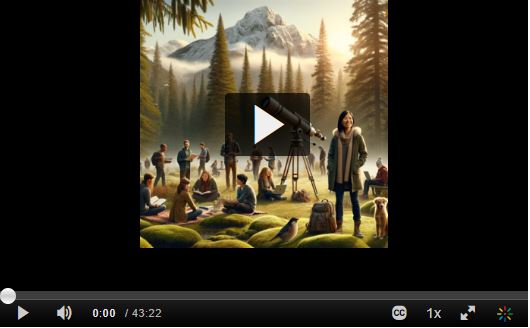
Click on the image above to listen to the recorded dialogue
Conversation between Jennifer Anaquod, Director, Indigenous Academic Initiatives, and Steven Bishop, Learning Designer, Academic Technology Services
Land Acknowledgement
Douglas College respectfully acknowledges that our campuses are located on the unceded traditional and ancestral lands of the Coast Salish Peoples, including the territories of the q̓íc̓əy̓ (Katzie), qʼʷa:n̓ƛʼən̓ (Kwantlen), kʷikʷəƛ̓əm (Kwikwetlem), xʷməθkʷəy̓əm (Musqueam), and qiqéyt (Qayqayt) First Nations.
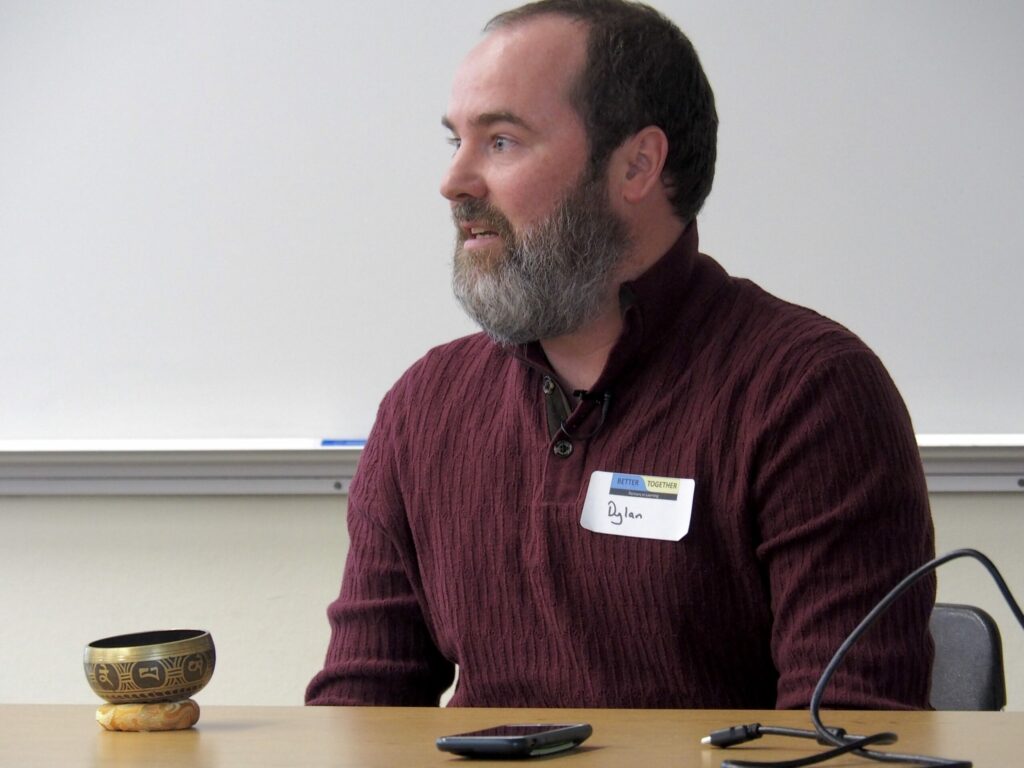
Dylan Le Roy is a Student Affairs and Services Counsellor at Douglas College, and provided a much-needed “Managing Uncertainty with Gratitude” session for the Better Together – Partners in Learning Conference May 2-6, 2022 at Douglas College. Dylan’ sessions was delivered in-person, and streamed to remote participants as well.
Dr. Rick Hansen The Neuroscience of Lasting Happiness “In every moment, you and I and everyone and everything else – from quantum foam to fleeting thoughts, intimate relationships, rainforest ecosystems, and the stars themselves – are each a kind of standing wave, like the ever-changing though persistent pattern of water rising above a boulder in a river.”
Tree of Contemplative Practices – “…the roots symbolize the two intentions that are the foundation of all contemplative practices: cultivating awareness and developing a stronger connection to God, the Divine, or inner wisdom.”
Jacob Goldowitz is one of the Learning Designers at Douglas College, and was a big part of envisioning and organizing the Better Together – Partners in Learning Conference May 2-6, 2022 at Douglas College. The conference sessions were delivered in-person, and virtually. Stay tuned for more episodes
This month, Steven met up for a virtual hallway chat with Tracy Ho, the Organizer-Advocate and Ombudsperson for Douglas Students’ Union. Tracy shared her insights based on student experiences taking courses during the 2020 emergency education delivery. We discussed things we learned and hopeful indications for the future.
Last month, Steven and I met up for a virtual hallway chat with Joseph Thompson, a Faculty Member in the Department of Psychology at Douglas College since 2019. Joe shared with us some of his experiences with online teaching this past Summer 2020, as well as some of his plans as he steps into the role of Facilitating Faculty Online (FFO) for HSS. Joe also discussed some of the ways his research can help us understand the process of building expertise, as it relates to the transition to being online instructors.
Join the conversation by sharing your comments, observations, and suggestions with us!
Until next time,
Lisa and Steven
Digital Humanity is recorded on the unceded traditional territories of the Coast Salish Peoples of the QayQayt and Kwikwetlem First Nations.
Joe does not want to give the impression that intelligence tests have always been used ethically or that scientists are incapable of bias. For a brief discussion of the history of racism in intelligence testing see
Benjamin, L. T. Jr. (2007). A Brief History of Modern Psychology. Blackwell.
For more information on the ethics behind the use of assessment tools, see
American Psychological Association (2017). Ethical Principles of Psychologists and Code of Conduct. American Psychological Association. Retrieved Dec 11, 2020 from apa.org/ethics/code.
For background on Transfer, see
Kimball, D. R., & Holyoak, K. J. (2000). Transfer and expertise. The Oxford handbook of memory, 109-122.
For the study behind Joe’s reference to basketball, see
Keetch, K. M., Lee, T. D., & Schmidt, R. A. (2008). Especial skills: Specificity embedded within generality. Journal of Sport and Exercise Psychology, 30(6), 723-736.
For the notion that chess could serve as a model organism for cognitive science see
Simon, H. and Chase, W. (1973). Skill in chess. American Scientist, 61. 393–403.
We have only glossed over the messy process by which psychologists use science to improve their psychological tests. For further reading on the history and philosophy behind this process, see
Slaney, K. (2017). Validating Psychological Constructs: Historical, Philosophical, and Practical dimensions. Palgrave Macmillan
For background on Joe’s research methodology, see
Thompson, J.J., Blair M.R., Chen L., Henrey A.J. (2013) Video Game Telemetry as a Critical Tool in the Study of Complex Skill Learning. PLoS ONE 8(9). https://doi.org/10.1371/journal.pone.0075129
This week Steven and I met up for a virtual hallway chat with Jovian Radeshwar, a Faculty Member in the Department of Political Science at Douglas College. We were also joined by our invited co-host, Rim Gacimi. Rim is a recent graduate from the Bachelor’s of Psychology program at Douglas College. Rim was an honours student and research assistant to Dr. Lisa Smith. Her work aims to better understand social behaviour and inequality using empirical research methods. Rim is also interested in socio-political discourse and was once a student of Dr. Jovian Radheshwar.
Jovian is a creative and enthusiastic instructor, who does not shy away from tackling everything under the sun when diving into international politics. We caught up with Jovian to chat about some of the ways he’s approaching the design of his online courses this fall. In addition, we wanted to hear his thoughts on how anti-racist pedagogy can help us navigate the chaotic world we find ourselves in.
This week Steven and I met up for a virtual hallway chat with Kira Tomsons, a Faculty Member in the Department of Philosophy at Douglas College. Kira is an experienced and innovative online instructor who enthusiastically delves into new techniques and methods for engaging students in virtual learning environments. (She is also pretty good with stick people drawings!) She shared with us some of the ways she is setting up her courses for Fall 2020. In addition, Kira reflected on how feminist care ethics can help us consider how to care well in these novel times.
If you want to read further, Kira has some suggestions:
I’ve enjoyed working with and conversing with Florence Daddy a few times, and was pleased when we had this chance to record an interview.
Current Teaching Florence Daddey, currently teaching in the Faculty of Commerce, Business and Administration in the Business Management Department
Background I am grateful for the opportunity to have lived in 3 continents. I was born in Ghana- West Africa, lived in England where I did most of my post secondary education and then moved to Canada in 2003. After University, I trained with Price Waterhouse in London to be a Chartered Accountant. I quickly realized that I did not enjoy auditing and through many volunteering opportunities with youth in inner city London, I discovered my passionate and love of teaching. Therefore, I decide to choose education and teaching as a career. In the last 17 years, I have had the opportunity to work as an instructional designer-supporting faculty in developing curriculum for different programs and supporting faculty in adopting appropriate teaching and learning pedagogy for their context in which learning takes place. In addition, to that I support faculty in using technology to support teaching and learning and I think we met each other attend various Educational Technology User Group – (ETUG) workshops. Given my personal experiences, I’m passionate about accessibility, inclusion and diversity issues. I’m certainly aware of the numerous barriers that can prevent certain groups of students in accessing post secondary education. Growing up in Ghana I quickly became away of my status and privileges. I witnessed true poverty where my family provided for many children. However, in Western nations we are given the impression that there is no poor person and the social security system is a buffer. As I engage with students I quickly realized that is not the case so I develop a passion for open education practices and advocates how the use of open textbooks and resources can benefit both faculty in terms of having control over your teaching resources and materials and helping reduce the educational cost for students.
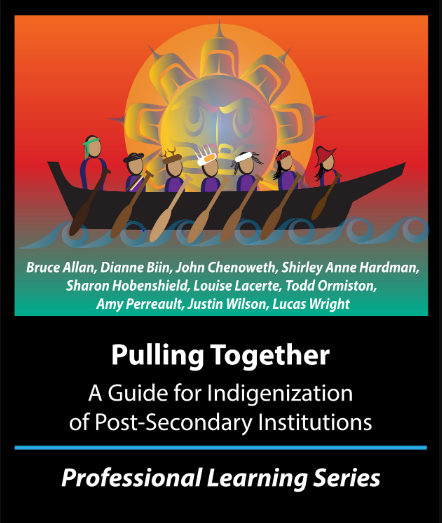
“How can we respond, in our roles, to the increasing calls for change? Especially in regards to post-secondary education?” It is important to decide what is important to you about teaching and your pedagogical belief and identity. I want my students to have a positive learning experience and especially in the current environment where a lot is changing around us and the change is happening so quickly. I have to take a step back and reassess my purpose and my role as an instructor. By doing that, I’m able to figure out how best to use all the tools and resources available to meet my needs and to adopt an appropriate pedagogy for the student to learn given the context and learning environment. In my practice, I get students to think about the learning environment as a community and the importance of building relationships. I like referring to the image on the text book “Pulling Together: A guide for Indigenization of post-secondary institutions. A professional learning series”.
Different cultures emphasize the importance of family and community and I try to use that belief to our classroom and learning experience. I emphasis the strengths within a learning community and I promote learning through collaboration and get students to appreciate the contributes of everyone to our learning. So, as I think about my discipline in the light of all the calls for actions I’ve certainly considered the changes that I can make, for example, by bringing indigenous perspectives and knowledge to our conversations as we discuss leadership.
I use examples of indigenous entrepreneurs and highlight their stories, how Indigenous businesses are set up… to give back to their communities. Even if it’s for profit, it’s not always individual profit but share. Let these be reflected in the textbooks and materials that students are reading, along with other ways to use stories from minorities and ethnicities. Faculty can create their own materials and resources reflecting inclusivity and diversity by engaging in open education. We can help change the narrative, and consider the impact on students who may have financially challenging situations by creating and adopting more open educational resources and strategies.